
The Koralm Kombinatorik Kolloquium (“KoKoKo”) is an annual workshop on enumerative and analytic combinatorics usually held on either side of the Koralm in Austria.
2026
KoKoKo 2026 will take place on 4th December at TU Graz.
More information will be available in due course.
20252025-03-17TU Graz
Organizer: Stephan Wagner
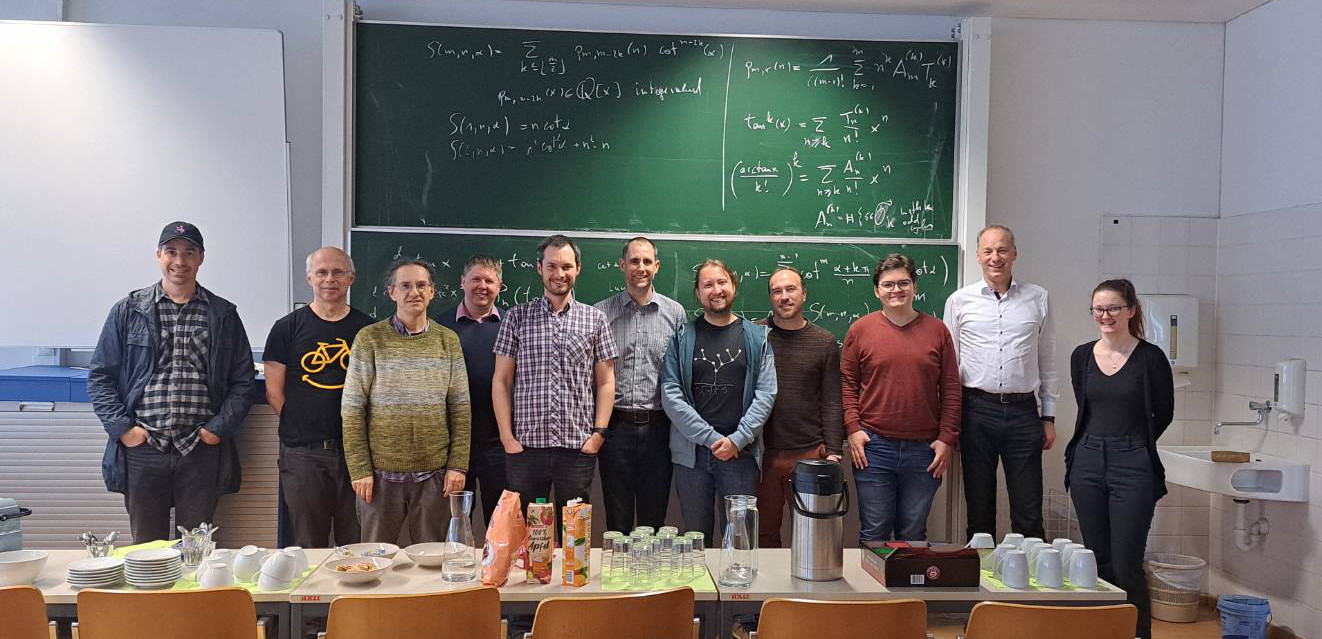
Morning Session Steyrergasse 30, Room AE01
- 10:00
- James Sellers University of Minnesota DuluthSurprising Connections Between Integer Partitions Statistics: The Crank, Minimal Excludant, and Partition Fixed Points
- 10:50
- Michael Wallner TU GrazEnumerating king walks avoiding a quadrant
- 11:20
- Andrei Asinowski University of Klagenfurt-avoiding rectangulations and inversion sequences
- 12:00
- Lunch Break
Afternoon Session Steyrergasse 30, Room A111
- 13:30
- Emily Lobnig University of KlagenfurtEnumeration of generalized Motzkin paths with negative boundary
- 14:00
- Daniel Brosch University of KlagenfurtCombinatoric Derivations and Sidorenko's Conjecture
- 14:30
- Daniel Krenn University of SalzburgGraphs with 2-regular distance-2 graphs
- 15:00
- Coffee Break
Open Problem Session Steyrergasse 30, Room A111
- 15:30
- Benjamin Hackl University of GrazThe surprising distribution of the global dimension of linear Nakayama algebras
- 16:00
- Franz Lehner TU GrazSums of cotangents
- 16:30
- Further Open Problems
20242024-02-10University of Klagenfurt
Organizer: Sarah Selkirk
Afternoon Session Room I.2.01
- 13:30
- Daniel Krenn University of SalzburgRegular Sequences, Part I
- 13:50
- Tobias Lechner University of KlagenfurtRegular Sequences, Part II
- 14:10
- Mario Kurnig University of KlagenfurtRegular Sequences, Part III
- 14:30
- Benjamin Hackl University of GrazOrdered trees and -Dyck paths
- 14:55
- Andrei Asinowski University of KlagenfurtGuillotine rectangulations and mesh patterns
- 15:20
- Michaela Polley University of KlagenfurtIntroduction to inversion sequences
- 15:40
- Sarah Selkirk University of KlagenfurtDichotomous results in the classification of generating functions
- 16:05
- Open Problem Discussion